Article
Vector Components English Study Handout
An English-first handout on vector components, vector operations, division points, and space vectors with short explanations and practice answers.
Vector Components Study Handout
1. Position Vectors and Components in the Plane
A position vector shows the location of a point from the origin. If point A has coordinates (a1, a2), then the vector OA can be written as a = (a1, a2).
In the xy-plane, we use two basic vectors:
e1 = (1, 0)e2 = (0, 1)
So every plane vector can be written in basic-vector form:
a = (a1, a2) = a1e1 + a2e2
This means the first number is the x-part, and the second number is the y-part.
Key words
- position vector: a vector from the origin to a point
- component: each coordinate of a vector
- basic vector: the standard unit direction, such as
e1ore2
Examples
- Write
a = (2, 3)in basic-vector form. - If
e1 = (1, 0)ande2 = (0, 1), what is(4, -1)in basic-vector form? - What does the second component of
(5, 7)mean?
Answers
a = 2e1 + 3e24e1 - e2- It is the
y-component, so it shows the vertical part.
2. Vector From One Point to Another and Component Operations
If P(p1, p2) and Q(q1, q2), then
PQ = (q1 - p1, q2 - p2)
This is a very important rule. We subtract the starting point from the ending point.
Vector operations can also be done component by component:
- equality:
(a1, a2) = (b1, b2)meansa1 = b1anda2 = b2 - addition:
(a1, a2) + (b1, b2) = (a1 + b1, a2 + b2) - subtraction:
(a1, a2) - (b1, b2) = (a1 - b1, a2 - b2) - scalar multiplication:
lambda(a1, a2) = (lambda a1, lambda a2)
From the source example:
OA = (-3, 2) = -3e1 + 2e2OB = (4, -1) = 4e1 - e2AB = OB - OA = (7, -3) = 7e1 - 3e2
Key words
- endpoint: the point where the vector finishes
- subtraction rule: end minus start
- scalar: a number that multiplies a vector
Examples
- Let
P(1, 2)andQ(5, 6). FindPQ. - Compute
(2, 3) + (4, -1). - Compute
2(3, -2).
Answers
PQ = (5 - 1, 6 - 2) = (4, 4)(6, 2)(6, -4)
3. External Division Point
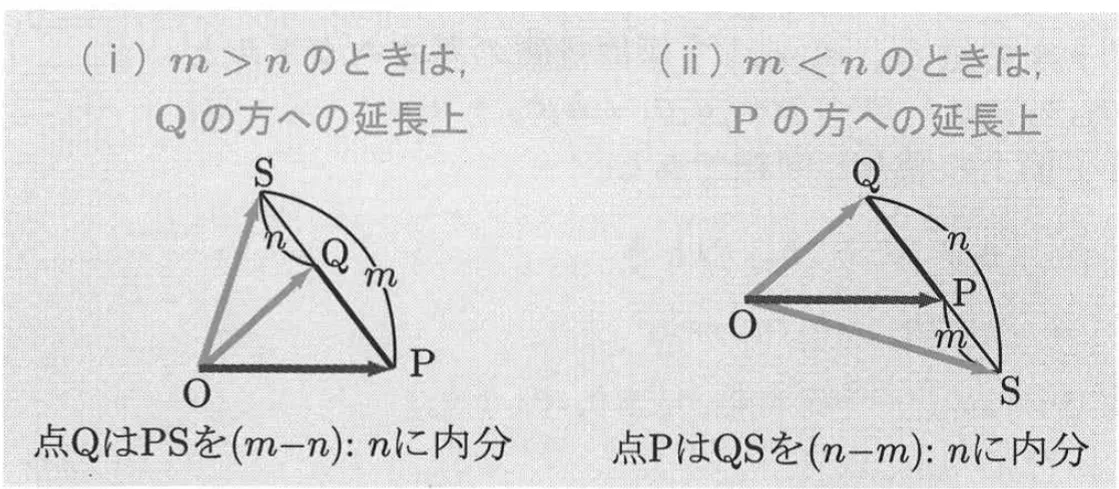
The source also introduces an external division point. If point S divides PQ externally in the ratio m : n, then the position vector of S is
OS = (-n OP + m OQ) / (m - n)
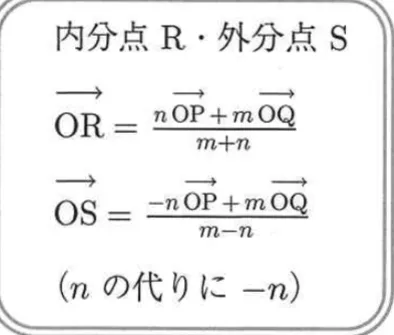
This formula is similar to the internal division formula, but the signs are different. Be careful here.
From the source example:
OP = (-3, 2)OQ = (-5, -1)SdividesPQexternally in the ratio2 : 5
Then
OS = (-5/3, 4)
Key words
- external division: dividing on the outside of the segment
- ratio: the comparison
m : n - formula: a fixed rule used to calculate something
我一直的记忆方式都是对边相乘,不过要能够记得,这个是比例,也就是SQ,PQ分别在总长SP中的占比
根据S在PQ内还是外来决定是内分还是外分
Examples
- In one short sentence, what is the difference between internal division and external division?
- In the external division formula, which vectors are used?
Answers
- Internal division is between the two points, but external division is on an extension line.
OPandOQ
4. Components in Space
In 3D space, a vector has three components. If point A has coordinates (a1, a2, a3), then
a = OA = (a1, a2, a3)
The basic vectors are:
e1 = (1, 0, 0)e2 = (0, 1, 0)e3 = (0, 0, 1)
So we can write
a = a1e1 + a2e2 + a3e3
For points P(p1, p2, p3) and Q(q1, q2, q3),
PQ = (q1 - p1, q2 - p2, q3 - p3)
Vector operations in space are also done component by component.
From the source example:
P(-2, -3, 5)Q(4, 1, -7)R(3, 6, 2)
Then
PQ = (6, 4, -12)PR = (5, 9, -3)2PQ - 3PR = (-3, -19, -15)
Key words
- 3D space: space with
x,y, andz - coordinate: a number showing position
- component form: writing a vector as a list of coordinates
Examples
- Write
(2, -1, 4)in basic-vector form. - If
P(1, 2, 3)andQ(4, 6, 5), findPQ. - Compute
(1, 2, 3) + (2, -1, 4).
Answers
2e1 - e2 + 4e3(3, 4, 2)(3, 1, 7)
5. Centroid and Linear Combination in Space
For a triangle in space, the centroid is the balance point. If the position vectors of the three vertices are OP, OQ, and OR, then the centroid G satisfies
OG = (OP + OQ + OR) / 3
This is a very useful shortcut.
From the source example:
P(-2, 4, 1)Q(4, 5, 2)R(4, 0, 3)
Then
OG = (2, 3, 2)
The source also shows how to express a vector as a linear combination:
OS = xOP + yOQ + zOR
For S(4, 23, 5), the result is
OS = 2OP + 3OQ - OR
Key words
- centroid: the center point of a triangle
- linear combination: a sum using numbers times vectors
- coefficient: the number in front of a vector
Examples
- What is the centroid formula for a triangle with position vectors
OP,OQ, andOR? - If
OP = (1, 0, 0),OQ = (0, 1, 0), andOR = (0, 0, 1), findOG. - In
OS = 2OP + 3OQ - OR, what is the coefficient ofOQ?
Answers
OG = (OP + OQ + OR) / 3OG = (1/3, 1/3, 1/3)3
Quick Review
- In 2D,
a = (a1, a2) = a1e1 + a2e2. - In 3D,
a = (a1, a2, a3) = a1e1 + a2e2 + a3e3. - To find
PQ, always do end minus start. - Addition, subtraction, and scalar multiplication are done component by component.
- The centroid of a triangle is the average of the three position vectors.
Missing or unclear source content
- The side notes and some small callout text in the images are not important for the main formulas, so they were not translated in detail.